Solo AI Agents Are Out. Multi-Agent Systems Are In. Here's What That Means for Your Business.
A single chatbot that answers questions is 2024's version of automation. What's changed is what happens after the reply — and it's the part most small businesses haven't automated yet.

A customer messages your business at 9pm. By the time you check your phone the next morning, a good AI agent has already replied. That felt like the finish line two years ago.
It isn’t anymore. A single chatbot that answers questions is 2024’s version of automation. What’s changing in 2026 is what happens after the reply — and that’s the part most small businesses haven’t automated yet.
Quick answer: One agent doing four jobs is the ceiling most small business automation runs into. The fix isn’t more automation — it’s better-divided automation: three or four narrow agents, each doing one job, with an orchestrator routing work between them and a human reviewing the edge cases. Most SMBs need three or four agents, not twelve.
The problem with one agent doing everything
Picture the old setup: one AI agent handling a customer inquiry from start to finish. It reads the message, decides if the lead is worth pursuing, updates your CRM, and sends a follow-up — all by itself, one step after another.
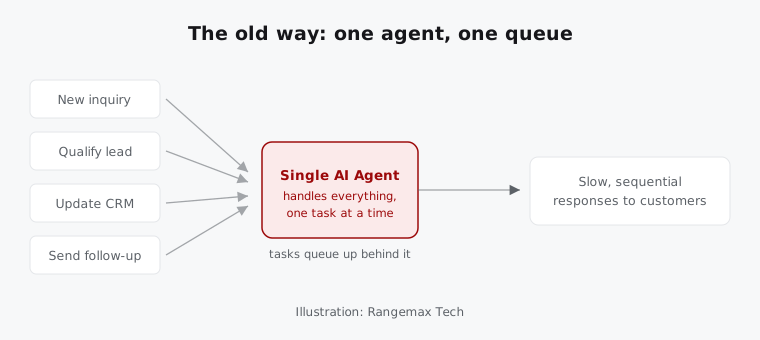
It works, until it doesn’t. Ask one agent to read intent, score a lead, write to your CRM, and compose a follow-up, and you’re asking one tool to be an analyst, a data-entry clerk, and a copywriter at the same time. Each of those jobs pulls the agent’s attention a different direction — and when one step drags, everything behind it waits.
That’s the ceiling most SMB automation has been running into. Not because AI isn’t capable enough, but because one general-purpose agent handling four different jobs does none of them as well as four agents each built for one.
What a multi-agent system actually looks like
The principle is older than the current wave of AI, and it’s the same one behind every well-run team: a specialist doing one job beats a generalist doing four. What’s changed in 2026 is that splitting work across coordinated agents has become practical at small-business budgets rather than enterprise ones — a handful of narrow agents, each doing one job well, managed by an orchestrator that routes the work.
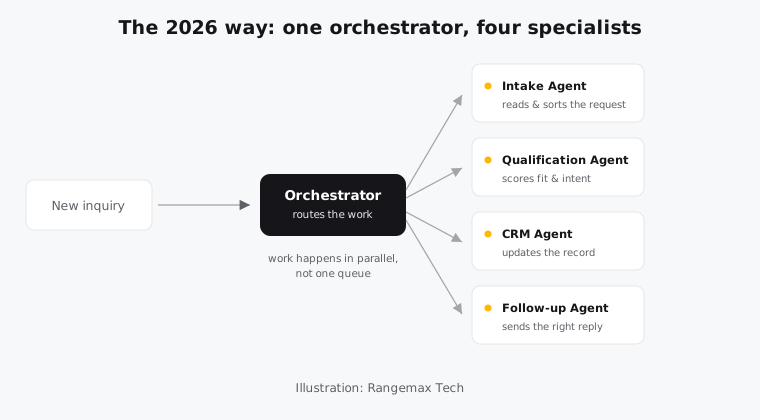
Here’s the same customer inquiry, handled the 2026 way:
- Intake Agent reads the message and sorts it — sales question, support issue, or spam.
- Qualification Agent scores whether this is a real lead worth a human’s time.
- CRM Agent logs the contact and updates the record, no manual entry.
- Follow-up Agent sends the right reply — a booking link for a hot lead, a resource for someone still browsing.
Each agent does one thing. They run in parallel, not in a queue. And because each one is narrow, it’s easier to test, easier to fix when it’s wrong, and easier to trust with the parts of your business that actually touch customers.
This is the same principle behind why Rangemax Tech builds automations as connected, single-purpose workflows rather than one do-everything bot — and why the first question we ask is what to automate first, and what to ignore. It isn’t a new idea, just one that’s finally practical for businesses your size.
Why this matters even if you’re not “an AI company”
You don’t need to understand agent orchestration to benefit from it. You need to know what to ask for.
If you’ve already set up basic lead qualification and it’s plateaued — replies feel generic, or the system chokes when volume picks up — a multi-agent setup is usually the fix. Not more automation. Better-divided automation.
The same logic applies past sales. A returning customer support question, an order status check, and a refund request are three different jobs. Routing all three through one agent is why so many “AI-powered” support setups still feel clunky. Splitting them across specialists — with a human still reviewing the edge cases — is why the good ones don’t.
The part nobody skips: keeping it under control
More agents doing more without a human checking every step is exactly the situation that makes business owners nervous, and they’re right to be. An orchestrator that routes work to the wrong agent, or an agent that acts on bad information, can move fast in the wrong direction.
This is where governance stops being an enterprise word and becomes a practical checklist: what can each agent actually touch, what requires a human to approve first, and what happens when something looks wrong. We go deeper on the real risks and who carries responsibility for them — worth reading before you hand any agent real access to customer data or your CRM.
It’s the same division of labour we argued for on the build side: AI does the boilerplate, a person owns the judgment. Agents are no different. The narrow, repetitive decisions can be delegated. The call about whether a decision was right cannot.
What to do with this if you’re a small business owner
You don’t need twelve agents. Most SMBs need three or four, built around the handful of repetitive decisions eating your team’s time right now — sorting inquiries, qualifying leads, updating records, routing follow-ups.
Start by naming the one task your team redoes most often, the same way, every single day. That’s the first agent worth building, and it doesn’t require code to stand up — here’s how to set up a first automation without writing any. Everything after that is sequencing.
If you’re already running some automation and it’s starting to strain — slow, generic, or breaking when volume spikes — that’s usually the sign you’ve outgrown a single agent and need a small system instead. Send us what you’ve got running today and we’ll tell you plainly whether it needs one more agent or a rebuild. No pitch, just a straight answer.
Frequently asked questions
What is a multi-agent system?
Several narrow AI agents, each handling one job, coordinated by an orchestrator that decides which agent gets which piece of work. It replaces the single general-purpose agent that tries to handle an entire process by itself.
How is that different from one AI agent?
A single agent runs tasks in sequence, so a delay in one step holds up everything behind it, and the same model has to be good at several unrelated jobs. In a multi-agent system the work runs in parallel, and each agent is narrow enough to test and correct on its own.
How many agents does a small business actually need?
Usually three or four, mapped to the repetitive decisions your team makes daily — sorting inquiries, qualifying leads, updating records, routing follow-ups. Twelve agents is an enterprise answer to a problem most small businesses don’t have.
Is a multi-agent system safe to let near customer data?
Only with limits set deliberately. Decide what each agent is allowed to touch, which actions need a human to approve first, and what happens when something looks wrong — before granting access to your CRM or customer records, not after.
How do I know if I’ve outgrown a single agent?
The usual signs are replies that feel generic, a system that slows down or breaks when volume spikes, and work that still lands back on a human because the agent handled it only partly. That’s a division-of-labour problem, not a reason to buy more automation.
Keep reading

Cut through the AI hype. See which AI agents actually save time and money for small businesses—with real examples and ROI data from 2026.
Read more →
Most small businesses don't need an AI agent. They need one repetitive task automated well. Here's how to tell the difference — and the real cost math.
Read more →
Forget the chaos of endless emails and WhatsApp threads. Here’s how Nigerian agencies, real estate firms, and travel businesses are using automation to save hours weekly and scale profits—without hiring more hands.
Read more →Want this implemented for your business?
Get a quick recommendation based on your goals, traffic sources and current setup.